



You Already Have the Data. That's the Problem.
Every click, every login, every abandoned application is a signal. Your systems are generating them around the clock.
Twenty years ago, community banks and credit unions started building data warehouses. The idea was straightforward: centralize your data and you could finally do something powerful with it.
Some institutions went further. One of my employers built a full data lake, hired a team of data scientists, and named a Chief Data Officer reporting directly to the CEO. They built predictive models. They presented the capabilities to the executive team.
The executives were not impressed. “Where are my usual reports?” some asked.
The “build it and they will come” strategy ran headfirst into an organization that wasn’t ready for it. The technology worked. The culture didn’t.
Then came Watson. IBM’s expert AI system generated enormous excitement in banking. Finally, a system smart enough to make sense of all that data. The problem was that Watson needed clean, well-structured data to function. Banking data is neither. Centralizing and cleansing it well enough to feed Watson turned out to be a project that could consume years and tens of millions of dollars. Most institutions never got there.
What survived Watson’s failure wasn’t skepticism about AI. It was something worse: the belief that your data must be perfect before you can do anything useful with it. That idea is still running loose in bank and credit union boardrooms today. And it’s costing you.
Every click, every abandoned application, every return visit is a signal. Most institutions are letting all of it go to waste.
The Data Is Already There
Here’s what most institutions miss. You don’t need a data lake to start. You don’t need a data science team. You need to look at what your account holders are already telling you, and they’re telling you quite a bit.
Start with your digital channel. Every time someone visits your website or logs into digital banking, they leave a trail. What products they looked at. What pages they abandoned. How long they spent on the auto loan calculator. Whether they started an application and stopped. This is behavioral data. It’s being generated every day. Most institutions aren’t doing anything with it.
That’s the crawl.
The walk is basic transactional signals, spending categories, product usage patterns, balance behavior. Many institutions have this data reasonably accessible already. Layering it into your personalization effort meaningfully sharpens what you can do.
The run is deeper transactional intelligence: life event detection from spending pattern shifts, financial stress signals, lending readiness from behavioral patterns over time. Real capability, real results, but it requires more infrastructure and more organizational readiness. It’s where you’re going, not where you start.
The point is that there’s a ramp here. You don’t have to boil the ocean to begin doing something useful.
What Those Signals Tell You
Even at the crawl stage, digital behavioral data is more revealing than most institutions realize.
Someone who spends fifteen minutes on your mortgage page and never applies is telling you something. Someone who logs in three times in a week and visits the personal loan section each time is telling you something. Someone who opens every email you send about auto loans but has never taken one out is telling you something.
These aren’t subtle signals. They’re direct expressions of interest that most institutions simply aren’t acting on because nothing in their stack is connecting the dots between what someone does and what that someone sees next.
Layer in basic transactional data and the picture sharpens further. Product usage patterns reveal relationship depth. Balance behavior suggests financial trajectory. Taken together, you start to see not just what members or customers are doing today but what they’re likely to need next.
Why It Isn’t Being Used
If this is so valuable, why isn’t anyone acting on it?
The honest answer is structural. Your data lives in silos, digital banking here, core processor there, card data somewhere else. None of these systems were built with activation in mind. They were built for processing.
Add the Watson hangover. A generation of bankers learned that data projects are expensive, slow, and politically treacherous. The data lake that took three years and never delivered. The CDO who left after eighteen months. The predictive model nobody used. Those experiences hardened into a belief that you can’t do anything until everything is perfect and centralized. Which means you never do anything.
The problem is structural. The solution must be too, which means starting where you can, not where you wish you were.
It Works
Lanier Federal Credit Union is a $66 million institution in Oakwood, Georgia. They used credit and share-of-wallet data to identify members who were likely candidates for auto loan refinancing, then ran a targeted, personalized campaign to reach them.
The campaign cost $1,000. In March 2022, it produced $2.7 million in funded auto loans, a record month. Eighty-five percent of that volume was directly attributed to the data-driven targeting.
One thousand dollars. One month. $2.7 million.
They didn’t have a data science team. They didn’t have a data lake. They had a clear question (which of our members has a loan somewhere else that we could be holding?), and a tool that could help them answer it. That’s the model.
What It Looks Like at Scale
Lanier FCU is one institution. But the pattern holds across the board.
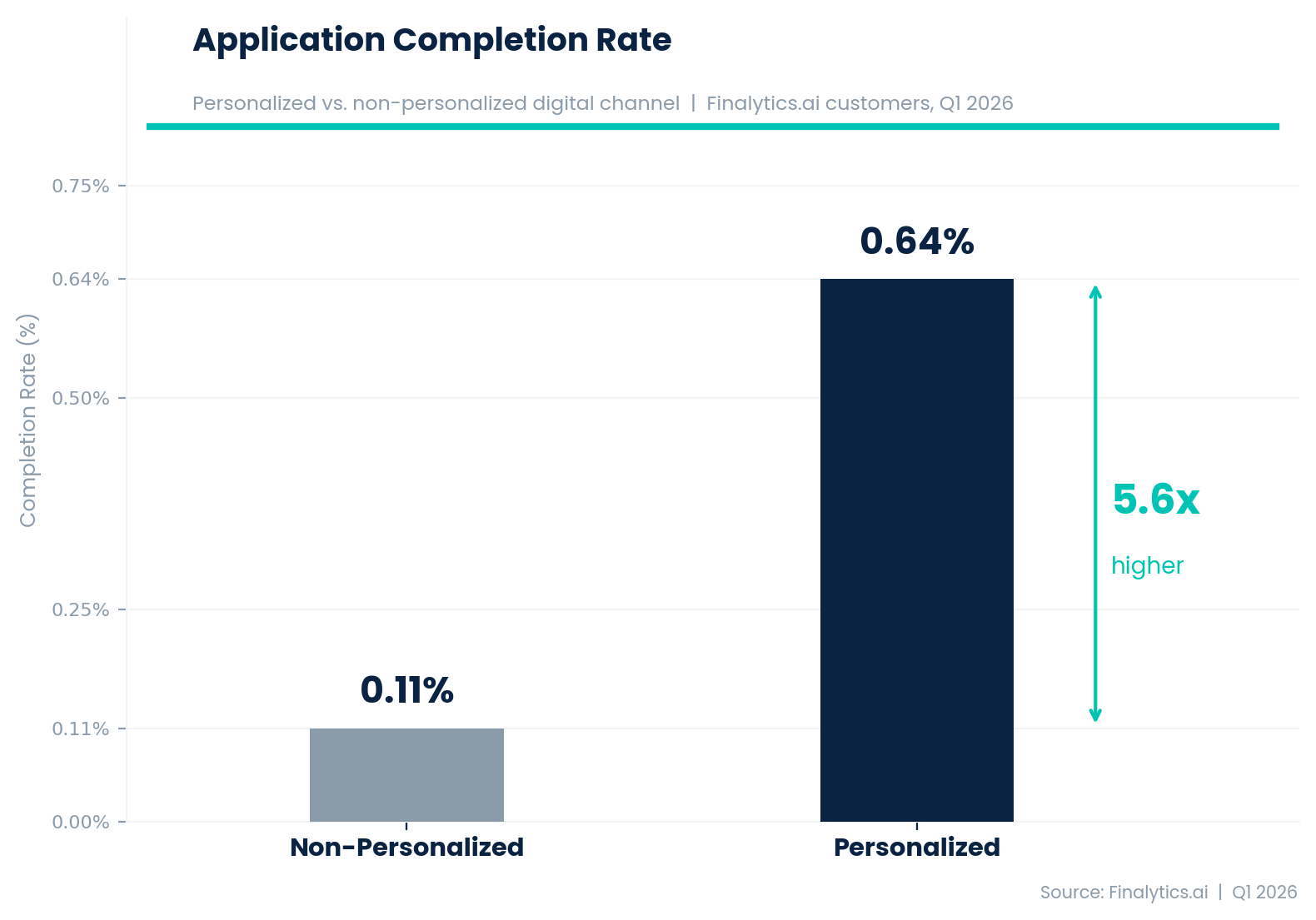
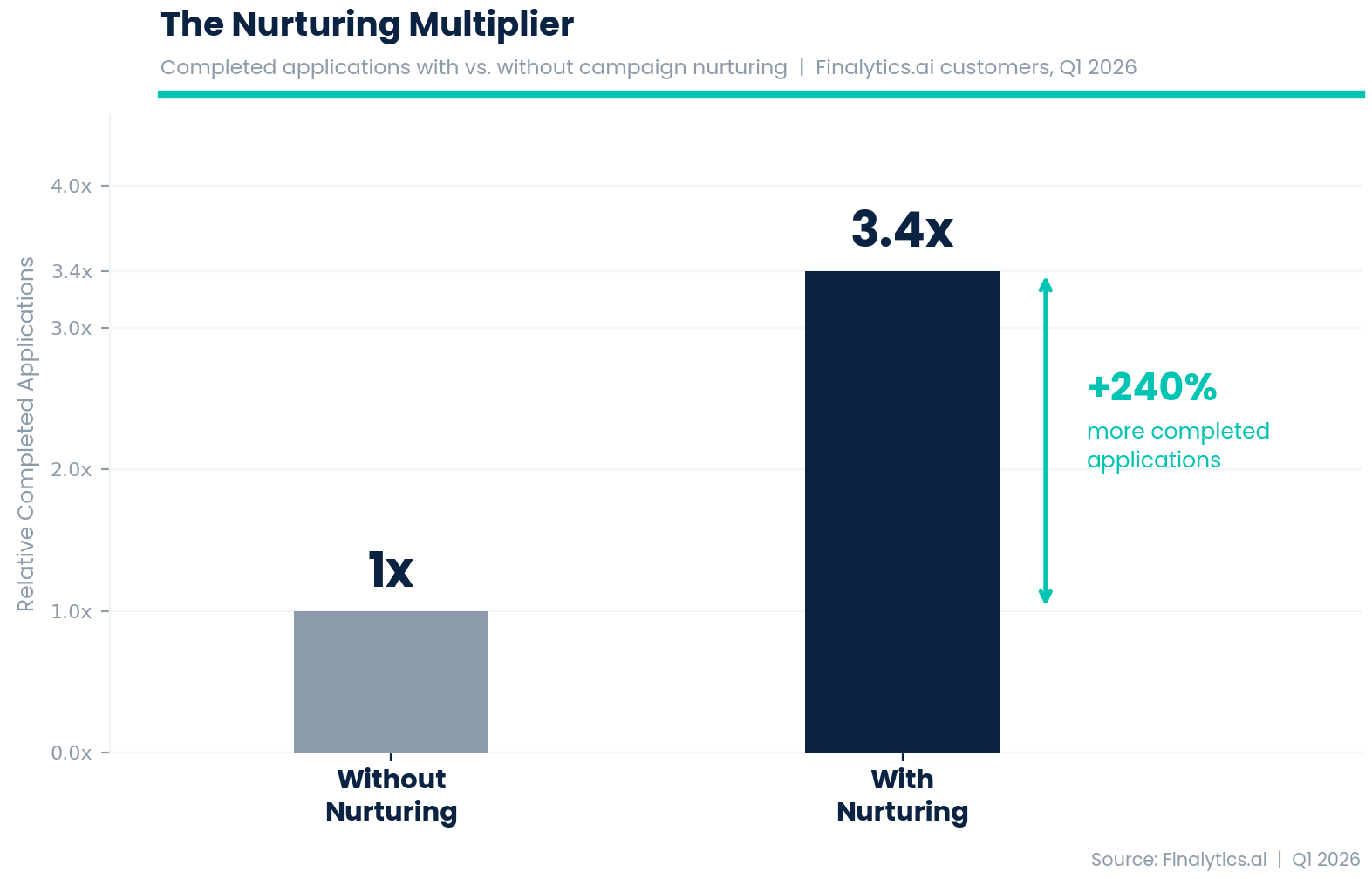
Across Finalytics.ai’s customer base in Q1 2026, personalization of the digital channel produced more than 14,000 completed applications, 5.6 times higher than the non-personalized benchmark. The personalized completion rate was 0.64% versus 0.11% for non-personalized experiences. Account holders receiving next-best product recommendations completed more than 2,300 applications. Campaign nurturing, following up with people who showed intent but didn’t convert, resulted in 3.4 times more completed applications, at a funnel re-entry completion rate of 7.5%.
These aren’t outcomes from data warehouse projects or multi-year transformation initiatives. They’re outcomes from reading the behavioral signals people are already generating in the digital channel and responding to them in real time.
That’s the crawl. And it’s producing results like that.
The Permission You Already Have
Your account holders gave you this data because they trust you. Not because they had to, because they chose your institution and have been conducting their financial lives through your systems for years. In some cases, decades.
Neobanks are spending enormous amounts of money trying to build that kind of relationship. They’re engineering engagement, gamifying saving, optimizing every touchpoint, all in service of becoming financially relevant to people who signed up for a checking account with a colorful debit card. They’re working hard for something you already have.
That trust is practical permission to use their data in ways that genuinely serve them. The compliance infrastructure to do it responsibly? You have that too. Use what you have. Use it like you mean it.
What To Do Tomorrow Morning
The gap between “this is interesting” and “we’re actually doing something” is where most data conversations go to die. Three things that don’t require a transformation initiative.
Audit what you’re capturing. Map your data sources and find out what behavioral and transactional data is being collected, what’s being stored, and what’s being discarded. You may be throwing away signals you didn’t know you had.
Pick one use case and run it. Start with digital behavior, it’s the most accessible. Find the people who are showing intent on your website and aren’t being followed up with. That’s your pilot.
Ask what your current technology can do. You may have data activation capabilities sitting unused in platforms you already own. Find out before assuming you need something new.