



Why Your Data Doesn't Need to Be Perfect
The post-mortem always blames your data. The real problem is usually the platform.
When an AI or personalization implementation falls short, the post-mortem almost always lands in the same place: your data wasn’t ready. The vendor says it carefully. Your team accepts it. Someone commits to an eighteen-month data cleanup project that costs more than the platform did.
That conclusion is usually wrong. And it is expensive to accept.
The obstacle for most community banks and credit unions isn’t bad data. It’s the assumption that data has to be perfect before anything can work.
This assumption comes from decades of thinking that AI, when ready to use our data, would require it to be easily accessible and always correct. It is why IBM’s Watson never made a dent in the banking world.
01
The Standard Was Set for Someone Else
Most AI and personalization platforms have been built for large enterprises with dedicated data engineering teams, unified data warehouses, and years of structured behavioral data prepared before deployment begins. That infrastructure has been the baseline assumption, not a future state.
The reality of all banks, and particularly community banks and credit unions, is that we are nowhere near that imagined state. Core systems run batch exports. Member records are spread across origination platforms, digital banking, CRM tools with inconsistent integration, and possibly data warehouses and even data lakes. Most organizations have little to no actionable behavioral data. Identity resolution across systems is rarely clean.
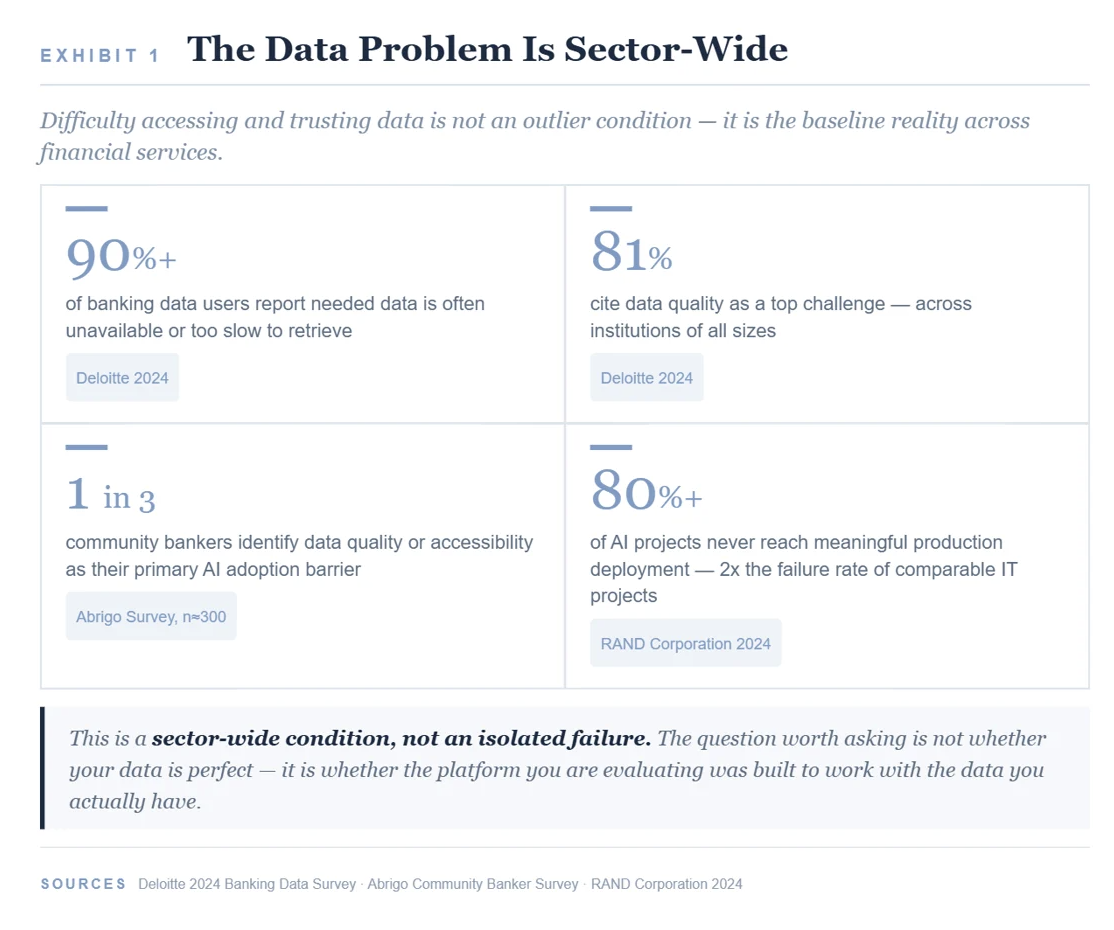
That is not a failure of prioritization. It is the operational reality of institutions that run lean and make rational resource decisions. A 2024 Deloitte survey found that more than 90% of banking data users reported that the data they needed was often unavailable or took too long to retrieve, and 81% cited data quality as a top challenge. An Abrigo survey of nearly 300 bankers found that roughly one-third identified data quality or accessibility as their primary AI adoption barrier. This is a sector-wide condition, not an isolated one.
Enterprise AI vendors rarely surface this gap during the sales process. Demos run on curated data. Implementations do not. The gap shows up after the contract is signed, and it gets called a data problem. Most of the time it is a fit problem. RAND Corporation’s 2024 analysis found that more than 80% of AI projects never reach meaningful production deployment — exactly twice the failure rate of comparable IT projects. The question worth asking is not whether your data is perfect. It is whether the platform you are evaluating was built to work with the data you actually have.
02
Five Dimensions Worth Examining Before You Commit
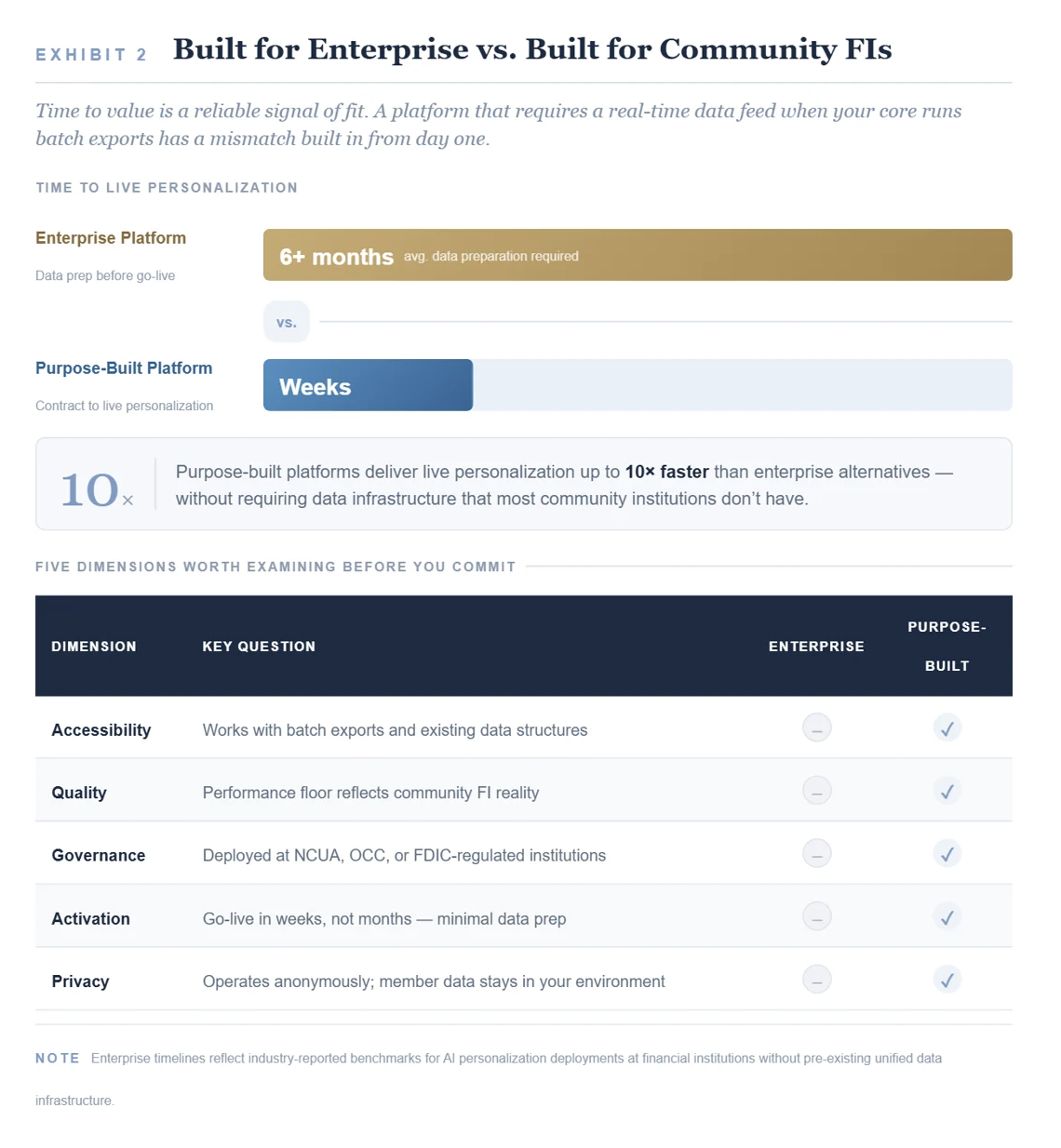
The following framework is a set of lenses for evaluating whether a vendor was built for your environment or someone else’s. Each dimension carries a question worth putting directly to any platform you are seriously considering.
ACCESSIBILITY
Can the platform work with how your data is currently structured and delivered, or does it require you to restructure first? A platform that requires a real-time data feed when your core runs batch exports twice a day has a mismatch built in from the start. Ask: what does your platform require at the data layer on day one, and what can be added over time?
QUALITY
Every platform has a floor — a minimum level of data completeness it needs to produce useful results. The question is whether that floor reflects your reality or an enterprise benchmark you were never designed to meet. Ask: what is the minimum data completeness your platform needs to deliver personalized experiences, and what happens to performance when that threshold is not fully met?
GOVERNANCE
Marketing personalization platforms designed for retail may not have thought carefully about the consent and compliance requirements specific to financial services. Ask: has your platform been deployed at institutions regulated by the NCUA, OCC, or FDIC, and how does it handle consent frameworks specific to regulated financial institutions?
ACTIVATION
Time to value is a reliable signal of whether a platform was designed for institutions like yours. A deployment that requires six months of data preparation before anything goes live was not built with your operating constraints in mind. Ask: what does a typical deployment look like from contract to live personalization, and what data preparation is required before go-live?
PRIVACY
What data does the platform collect, store, and transmit, and does any of it create compliance or member trust exposure? Governance is about how you manage data internally. Privacy is about what the vendor does with it once it leaves your environment. Ask: does your platform operate anonymously, and how is member data used outside of our specific implementation?
03
What Good Actually Looks Like
A well-positioned community institution does not need perfect data. It needs data matched to what the platform requires.
The bar is lower than most vendors will admit. A platform built for your environment works with the data you already produce, generates personalization from behavioral signals rather than complete member records, carries compliance into its design rather than bolting it on afterward, goes live in weeks, and handles everything on the public site anonymously. That is not a high standard. It is a reasonable one that too many platforms quietly fail to meet. Most institutions are closer to it than a failed implementation or an inflated vendor requirement led them to believe.
04
The Right Question
Data readiness is not a binary. Every institution is ready for something.
Before your next vendor conversation, the question that deserves an honest answer is not whether your data is ready. It is whether the platform you are evaluating was designed for the data you actually have. That question, asked before you sign, is worth more than any cleanup project you could run this quarter.
The right question for your next vendor conversation:
Was this platform built for the data you actually have — or for a data environment you don’t?