



The Personalization Paradox
Why 71% of Members Expect It But Only 20% of FIs Deliver
I’ve been in this industry for a long time, as a banker and as a consultant working with institutions from sub‑$1B CUs to national banks. Every year, I watch the same pattern: customer and member expectations race ahead, while many institutions slip further behind. Members expect their FI to know them, on the phone, in the branch, and in digital. Instead, we increasingly treat them like anonymous account numbers.
The data backs it up. McKinsey reports that 71% of consumers expect personalized interactions, and 76% get frustrated when they do not. More than 60% now expect their FI to understand their specific needs, and over half say they will switch if they don’t get it. We all know stated intent to leave doesn’t equal actual attrition, but this level of unmet expectation is a warning signal, not a footnote.
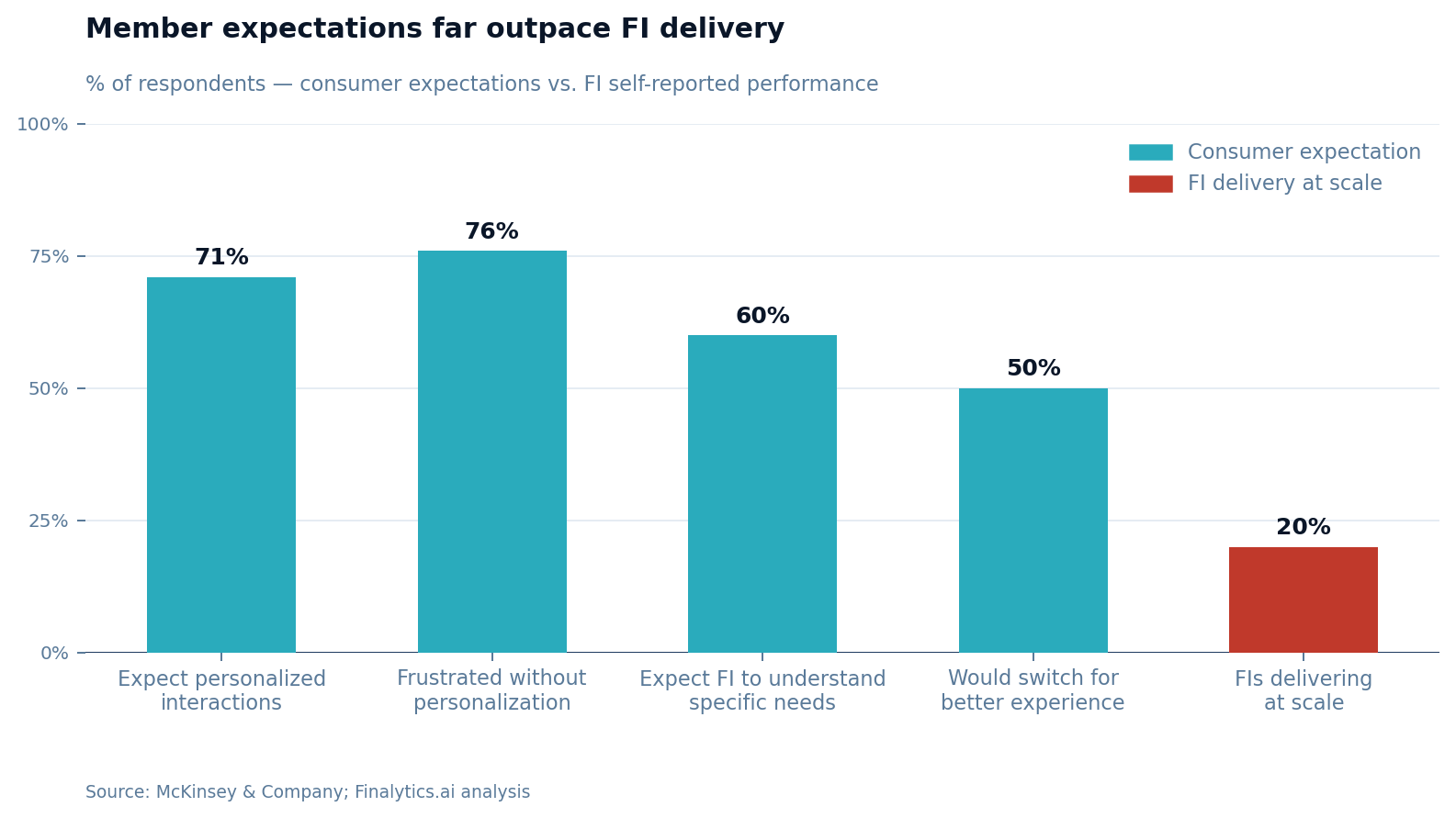
And yet only about 20% of financial institutions say they are delivering effective personalization at scale. That’s not a gap; it’s a chasm, and it’s costing community banks and credit unions members, deposits, and relevance every single day.
The Netflix Problem Has Come to Banking
Members no longer compare your app to the bank across town. They compare you to Netflix, Amazon, and Spotify, platforms that predict what they want before they ask. When Netflix nails the next show, when Amazon surfaces exactly the product you didn’t know you needed, when Spotify builds a playlist that matches your day, those experiences quietly reset expectations for every digital interaction, including banking.
The challenge for community institutions is obvious. You are now competing on personalization against firms with billion‑dollar AI budgets and engineering organizations larger than your entire staff. Large banks like JPMorgan are building similar capabilities in‑house. Community FIs don’t have to match that spend, but they do have to stop pretending the bar hasn’t moved.
Here’s the good news: you don’t need Netflix‑scale resources to deliver Netflix‑like relevance. You don’t need to rip and replace your tech stack. You need to activate the data you already have.
The Data You’re Sitting On (But Not Using)
Community banks and credit unions have something neobanks and big tech would love to own: deep, long‑term transactional insight into members’ financial lives. At a minimum, you already know:
- Every transaction a member makes
- Spending patterns and categories over time
- Life events: new baby, home purchase, job change
- Financial stress signals
- Product usage patterns
- Channel preferences
Meanwhile, personalization expectations are mainstream. Consumers increasingly expect their provider to use the data they already have to improve the experience, and a majority rate personalization as highly important in financial services. Yet most community FIs treat this behavioral goldmine like it does not exist. Batch‑and‑blast emails lead with “Dear Member” or “Dear Customer.” Product offers look the same for everyone. Digital experiences present identical content to a 25‑year‑old gig worker and a 65‑year‑old retiree.
The irony is painful: community institutions often have better first‑party data than the neobanks they worry about, but either don’t think of it as a strategic asset or don’t know how to put it to work.
The Business Impact Is Measurable
Choosing not to leverage this data, whether from capability gaps, risk concerns, or organizational inertia, has a direct financial cost.
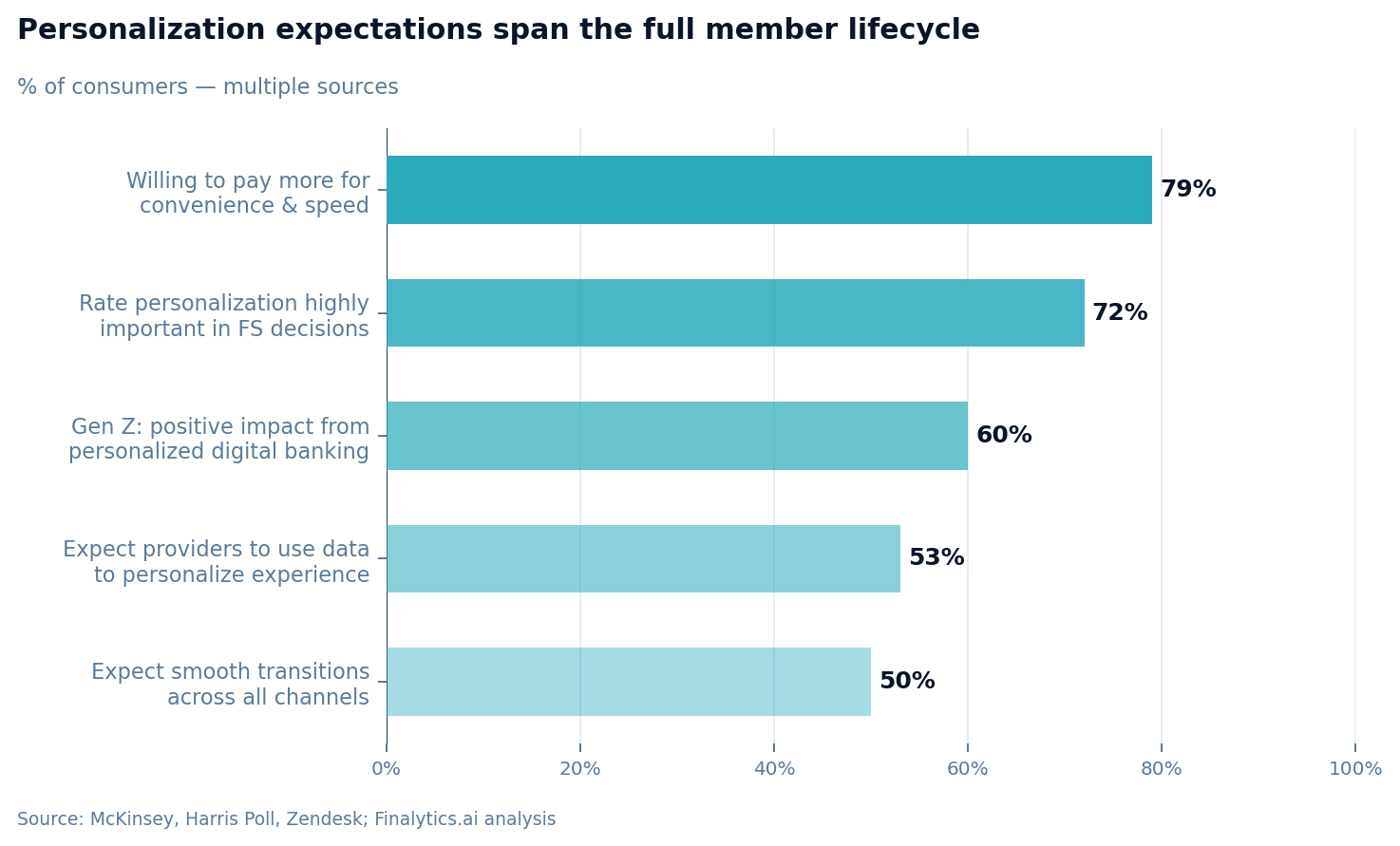
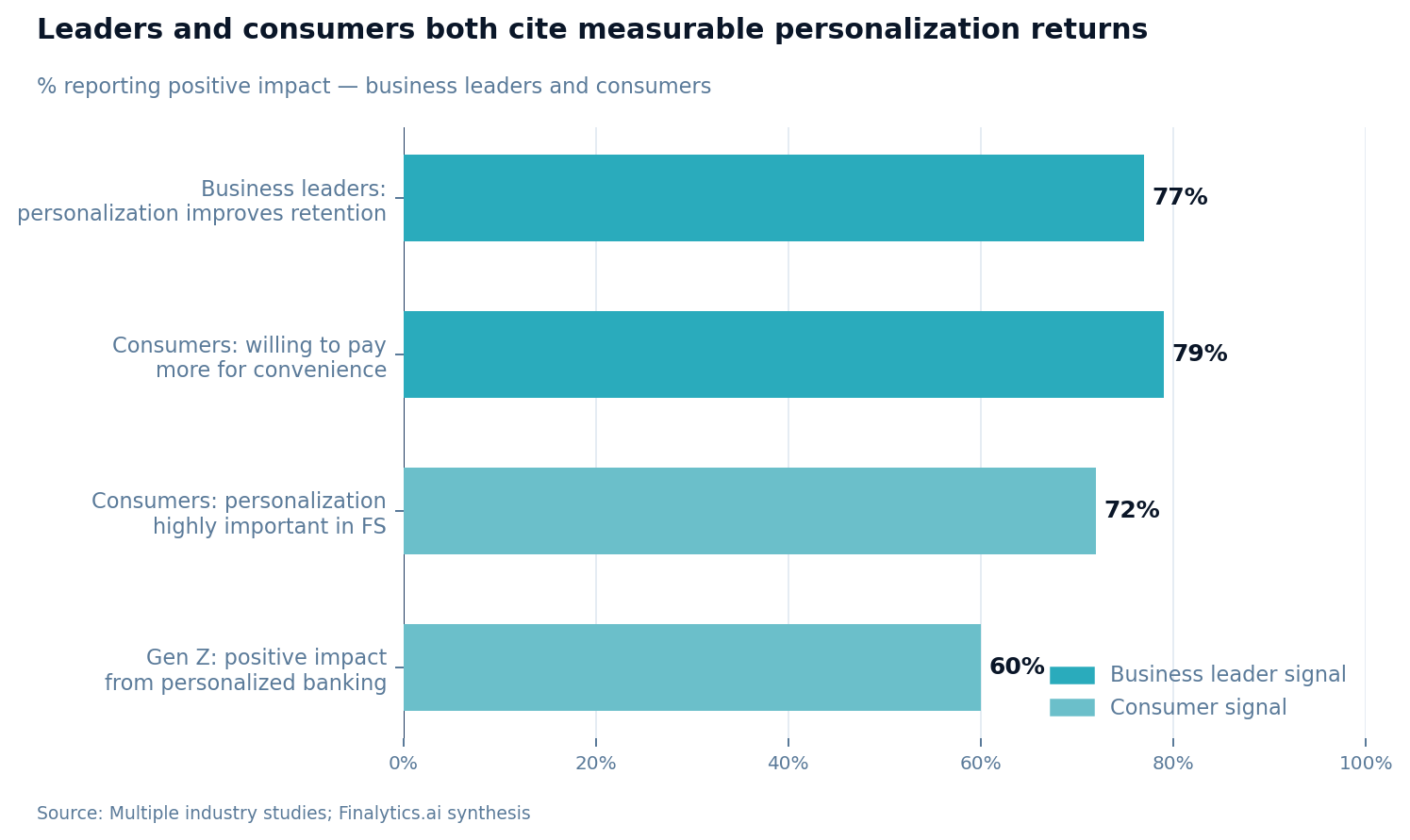
- 79% of consumers say they are willing to pay more for convenience and speed.
- 53% expect their providers to use the data they hold to personalize the experience.
- Around 72% rate personalization as highly important in financial services decisions.
- 77% of business leaders say deeper personalization improves retention.
- Forrester estimates that a 1‑point improvement in CX Index score can drive $123M in incremental revenue for a large multichannel bank.
- Nearly 60% of Gen Z report a positive impact on their financial habits and goals from personalized digital banking services.
Meanwhile, leading institutions are already leaning into this.
- Neobanks and digital‑only players are setting the baseline on convenience and personalization.
- Bank of America’s virtual assistant, Erica, has completed more than 2 billion interactions, serving over 42 million customers with personalized, context‑aware experiences.
This is not theoretical. This is where your competition is heading.
The Real Cost of the Personalization Gap
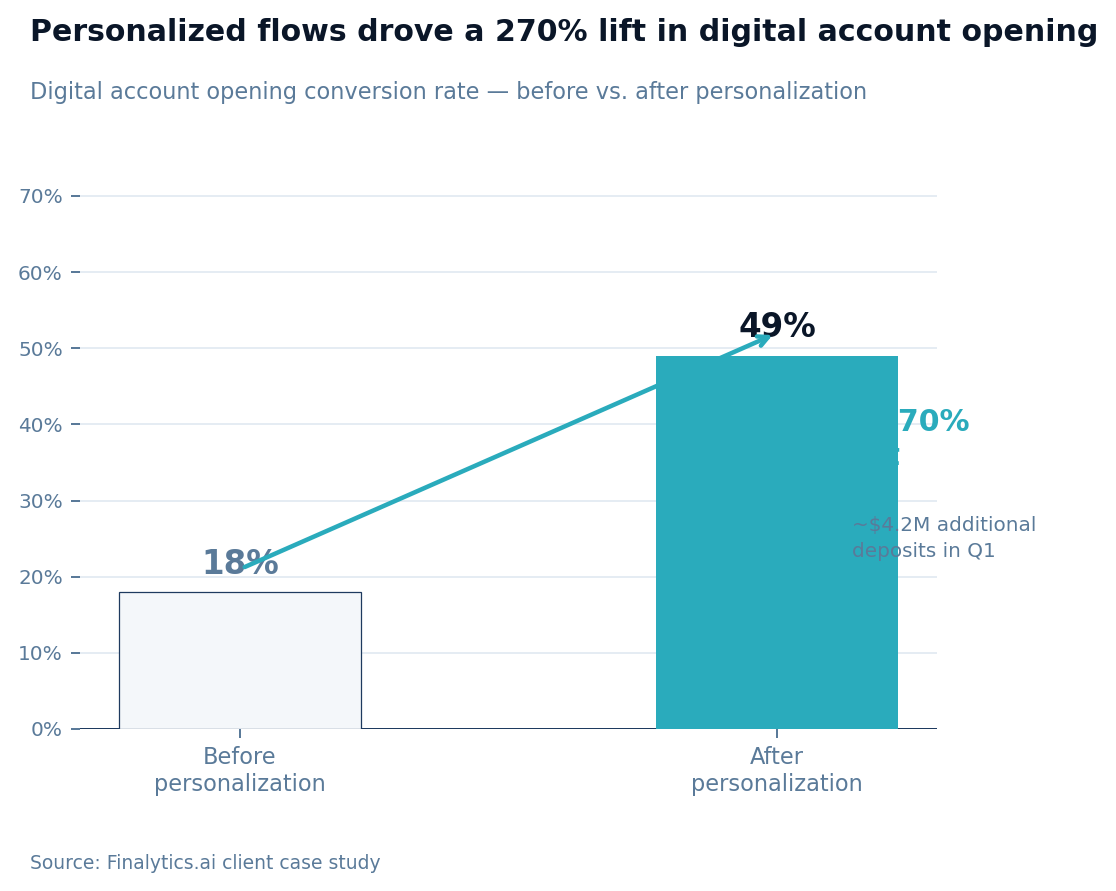
Not long ago, I worked with a financial institution struggling with digital account opening. They converted just 18% of people who started an application. That means 82% abandoned somewhere in the process, after raising their hand on the FI’s own site.
The problem was not the product; it was the one‑size‑fits‑all experience. A 22‑year‑old opening their first checking account endured the same 15‑page journey as a 55‑year‑old moving $250,000 from another institution. Same forms, same fields, same friction.
When they introduced personalized flows based on behavioral signals, they saw quick results:
- Returning visitors saw abbreviated forms, because the institution already knew who they were.
- High‑balance prospects saw priority support options.
- First‑time bankers saw educational content and guidance.
- Mobile users received a streamlined, three‑screen experience.
The result: conversion jumped to 49%, a roughly 270% lift from the original baseline, and there is still room to optimize. At their volume, that single change translated into $4.2 million in additional deposits in the first quarter. That is the personalization gap, quantified.
Five Myths Blocking Personalization
Myth 1: “We don’t have the data.”
You do. Your core and ancillary systems are capturing rich transactional and behavioral data every day. The real question is whether anyone owns the mandate to activate it.
Myth 2: “We need a massive tech overhaul.”
You don’t. Modern personalization platforms integrate with your existing core, digital banking, and CMS. You layer intelligence on top; you don’t start from scratch.
Myth 3: “Members don’t want personalization; they want human service.”
They want both. A majority of clients expect smooth, consistent transitions across channels, mobile, web, branch, and call center. Personalization makes every channel more relevant, including in‑branch conversations.
Myth 4: “We’re too small to compete on personalization.”
In reality, you have advantages: local knowledge, community relationships, and more flexible decision‑making. That combination can make you faster and more precise than a mega‑bank, if you use it.
Myth 5: “This is a privacy nightmare.”
Done right, personalization actually respects privacy. It means you show fewer irrelevant offers and more content that is genuinely useful. That builds trust rather than eroding it.
What Real Personalization Looks Like
Personalization is not inserting `[First Name]` in an email subject line. It is reshaping how members experience your institution.
Behavioral personalization
- Showing different homepage content for savers, borrowers, and investors.
- Adapting your mobile app layout to reflect the features a member actually uses.
- Surfacing relevant products or tools at the moment they are likely to be needed.
Life‑event detection
- Spotting when spending patterns suggest a new baby in the household.
- Recognizing a home purchase and proactively offering home equity, insurance, or budgeting support.
- Identifying early stress signals and offering options before delinquency.
Channel personalization
- Remembering preferences across web, mobile, branch, and the call center.
- Continuing conversations across channels without forcing members to repeat themselves.
- Adapting frequency, timing, and format of communications to individual preferences.
Predictive engagement
- Anticipating needs before members reach out.
- Recommending products that fit a member’s actual financial situation.
- Timing outreach to when they are most likely to respond.
This is “segment of one” in practice, not science fiction.
The Path Forward: What Community FIs Should Do Now
You don’t need a three‑year roadmap to get started. You need a focused, staged plan.
- Audit your data (this week)
Clarify what transactional and behavioral data you capture today, how accessible it is, and who owns activation. Identify obvious gaps, missing events, siloed data, or manual exports.
- Pick one high‑impact use case (this month)
Start where the business impact is clear and measurable, for example:
- Personalized digital account opening flows.
- Targeted loan or card offers based on transaction patterns.
- Customized digital banking homepages by segment or behavior.
- Evaluate your technology gap (this quarter)
Assess whether your digital banking platform and surrounding stack can support real‑time personalization. Identify required integrations. Decide where you need a platform versus where building in‑house even makes sense.
- Build the business case (this quarter)
Put numbers around it:
- Current conversion on key products.
- The dollar value of a 50% improvement.
- Member attrition to better‑personalized competitors.
- The lifetime value impact of deeper engagement.
Personalization moves from “nice to have” to “board‑level priority” when you can express it in dollars, not adjectives.
The Community Bank Advantage—If You Move
Despite the arms race at the top of the market, community banks and credit unions have real structural advantages:
– Longer relationships = more comprehensive financial histories.
– Local market insight = context for what is happening in members’ lives.
– Established trust = permission to use data for the member’s benefit.
– More flexible operations= the ability to move faster once you decide.
The question is not whether you can compete on personalization. It is whether you will act before the gap becomes too wide to close.
A Real‑World Example: Closing the Gap
Visions Federal Credit Union faced the same challenge many institutions see: members expected tailored digital experiences, but their platform treated everyone the same. They implemented a real‑time AI personalization layer that uses behavioral, transactional, and demographic data to dynamically change what each member sees when they log in or visit the website.
The outcomes:
- Around a 270% increase in conversion on targeted digital campaigns.
- New, discrete market opportunities surfaced from member behavior that had previously been invisible.
- Industry recognition and awards for digital experience innovation.
They did not rip out their core or rebuild their website. They turned on personalization that works with the stack they already had and activated the data that was sitting idle.
The Bottom Line
The personalization gap is not a future risk; it is a current drag on growth, deposits, and loyalty. Every quarter you delay, the leaders widen the gap and the cost to catch up increases.
You already have the data. You already have the relationships. You already have the local advantage. What you need is the activation layer that converts those strengths into the personalized experiences members increasingly expect as standard.
The 20% of institutions delivering personalization at scale are not waiting for a perfect roadmap. They are starting with high‑impact use cases, proving value fast, and scaling from there. The real question for your organization: will you join the 20% that deliver personalization—or watch your best members migrate to those that do?