



The Deposit Relationship That Almost Was: Three Places Where the Experience Breaks Down
Most deposit growth initiatives focus on generating demand. Few institutions manage what happens after that demand shows up: how well it converts, whether relationships deepen, and whether customers stay. That's where the growth is being lost.
Over a decade ago, I worked at a community bank where I owned deposit products, along with several other areas. ALCO meetings regularly centered on the same issue: we needed more deposits. Like most institutions, we focused on the usual levers, products, rates, and marketing.
In one of those discussions, our newly hired CMO projected millions of dollars in new deposits from a “digital direct” brand built around a market-leading CD rate. I also ran digital at the time. I was skeptical of the projections, but the idea of a direct brand was exciting, and I backed him. Those of you around at the time will remember how fashionable it was.
Our teams moved quickly. We came up with the brand name, which was a shortened version of the bank’s name followed by the word “direct.” We designed a “millennial logo.” We priced the CD above the market rate and listed it on Bankrate.
Traffic to the landing page quickly grew. Applications started. But they didn’t turn into funded accounts. After a short period, the initiative was shut down by our CFO, who wasn’t convinced that buying market share was the way to go.
At the time, it was easy to question the idea of a direct bank brand and the hasty rollout. Looking back, the issue was simpler.
We had demand, but didn’t have the ability to convert it and hadn’t changed the experience.
Our website remained a brochure. Account opening wasn’t optimized for completion for the new CD or any of our existing products. Existing customers weren’t recognized when they tried to apply. Our digital platforms (browser and mobile) couldn’t support the journey we were trying to create, nor a separate brand.
We treated digital as something our vendors provided, not something we managed.
That pattern still shows up today, regardless of the changes that the last decade has brought.
Institutions invest in rates, products, and marketing to generate demand. They see engagement in digital channels. But they don’t consistently manage what happens next, how well that interest converts, how relationships deepen, or how journeys carry across channels.
The result isn’t dramatic. It shows up as incremental loss: abandoned applications, missed opportunities to expand relationships, customers who keep an account but move new deposits elsewhere. We never look at the full picture.
Over time, those gaps compound into a meaningful drag on growth. This is not a demand problem. It is a digital experience problem. And it shows up in three places: conversion, expansion, and retention.
“Most institutions aren’t losing deposits at awareness. They’re losing them at the moment of intent, when someone has already decided to open an account, but the experience doesn’t carry them through.”
Mistake #1: Friction in Account Opening Suppresses Conversion
Here’s what most institutions don’t measure: how much value disappears between the moment someone decides to open an account and the moment it’s actually funded.
Most institutions open accounts the way their platform vendor built it, with compliance and operational requirements baked in and very little flexibility to change the experience. In practice, it’s one of the most direct conversion points in the deposit lifecycle, and it’s underperforming at nearly every institution I’ve worked with.
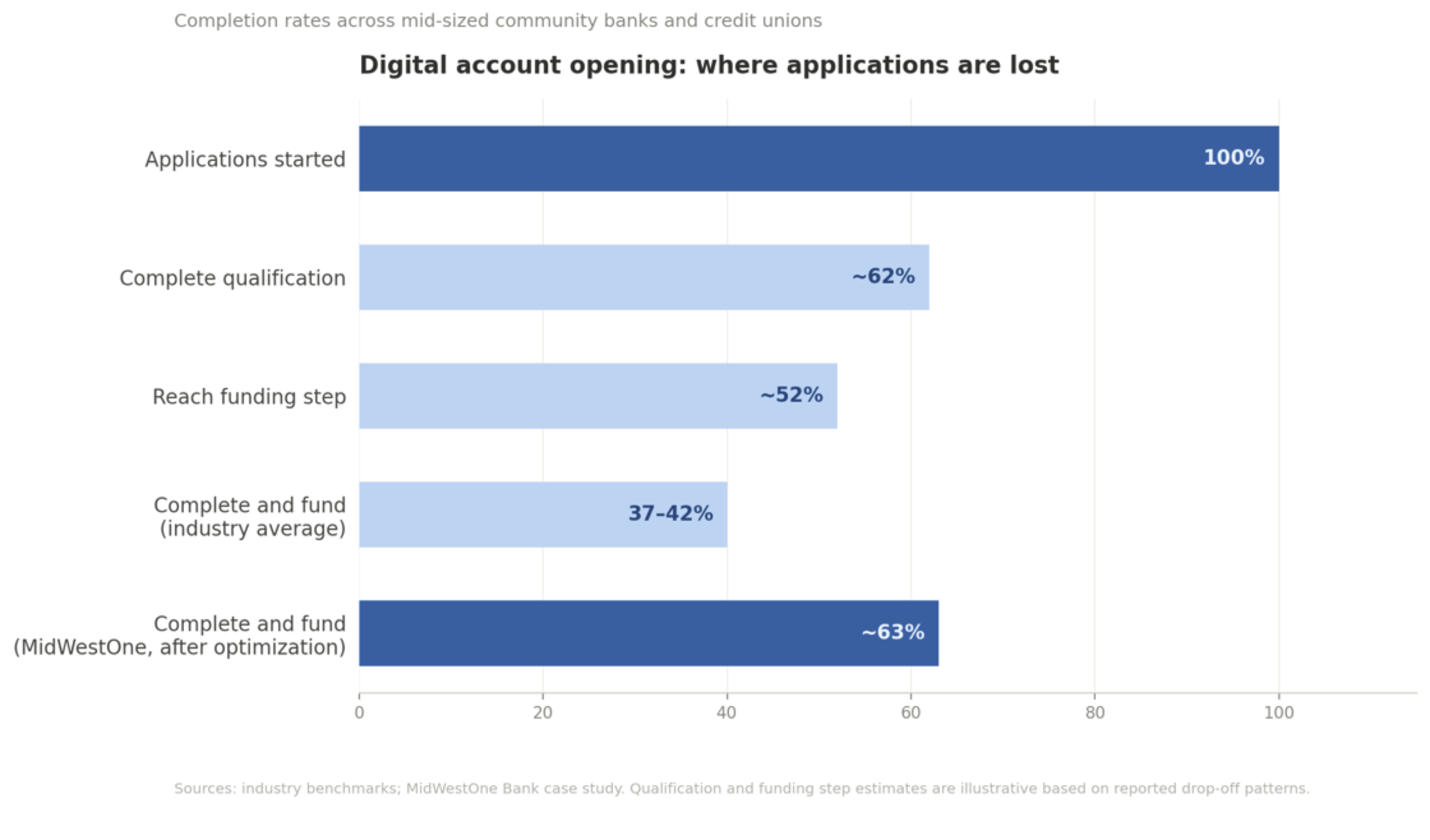
Across mid-sized institutions, completion rates for new-to-bank applications typically fall in the 37–42% range, with overall abandonment around 55%. Drop-off happens early, during qualification, and again at funding. Poorly calibrated fraud screening stops applicants before they ever reach the funding step. Funding schemes vary, but often add more friction; for example, micro-deposits add delays. Mobile experiences still behave in many cases like they were designed for a desktop form in 2009.
The evidence that this can improve is clear. MidWestOne Bank simplified onboarding through prefills and streamlined verification. Completion rates climbed to roughly 63%, mobile became the dominant channel, digital account volume doubled, and fraud outcomes improved.
The point isn’t the tactic. It’s that conversion improved without touching product or rate strategy. At Finalytics, conversion rate is one of the first things we look at, because it’s where the most recoverable value usually is.
Most institutions aren’t losing deposits at awareness. They’re losing them at the moment of intent, when someone has already decided to open an account, but the experience doesn’t carry them through.
Mistake #2: Ignoring Behavioral Signals Suppresses Expansion
Most community institutions already have more behavioral insight than they use. No, really.
The problem isn’t a lack of data. It’s that the data rarely gets turned into action fast enough to matter.
Behavioral modeling is well developed at the portfolio level. Institutions understand deposit stability, pricing sensitivity, and liquidity behavior in aggregate. That same sophistication is rarely applied at the individual customer level, in real time, when it could actually change an outcome.
The signals are already there: repeated product views, rate checks, large idle balances, abandoned applications, engagement patterns tied to liquidity events. None are perfect on their own. Together, they indicate active intent.
I saw this play out directly. Our head of retail wanted to identify customers who had just moved large deposits into the bank so we could follow up with CD, IRA, or wealth management offers. The data existed. We could pull the reports. But by the time anyone reached out, the funds had already left. The signal was real. The timing wasn’t. It’s one of the problems Finalytics was built to solve.
The fix isn’t sophisticated. Detect the signal. Decide on the next step. Execute before the moment passes. That’s it. The industry has dressed this up in enough jargon that it feels harder than it is.
Most institutions aren’t missing signals. They’re missing the ability to act on them while they still matter.
Mistake #3: Channel Inconsistency Creates Friction That Erodes Relationships
When we first introduced digital account opening, I rolled it out across both the website and the contact center. It made sense, customers were going to use both, and we wanted the experience to work regardless of where they started.
After the pilot, our compliance team had us pull it from the contact center. Their concern was legitimate: they couldn’t guarantee that customers were reviewing disclosures before agreeing to them. So, we removed it.
What we didn’t fix was the gap that created. The contact center lost visibility into what customers were doing online. The platform wasn’t flexible enough to solve the compliance problem in a way that kept both channels connected. We made a reasonable decision and eliminated the possibility of the two teams working together.
Nobody set out to create a broken experience. The fragmentation was the byproduct of a compliance call, a platform limitation, and an organizational structure that had no mechanism for closing the gap afterward.
That’s how it usually happens. Not a single bad decision, but a series of reasonable ones that nobody ever went back to reconcile.
Most institutions still carry versions of that story in every channel they operate. Digital, branch, and contact center each have their own systems, their own data, their own constraints. Customers don’t know any of that. They just know the experience didn’t work.
The impact shows up in behavior. Abandonment increases in fragmented journeys, repeat contacts rise, and customers frequently cite inconvenient experiences, not pricing or product, as a reason for leaving.
Customers don’t think in channels. They expect continuity. When it’s not there, the relationship degrades.
You already have the demand. The question is what you’re doing with it.
Conversion breaks at the point of intent. Expansion breaks between signal and action. Retention breaks when the journey doesn’t carry across channels.
Here’s the thing that still bothers me: none of this requires new demand. The applicants are already there. The signals are already firing. The customers are already engaged, until they aren’t.
What’s missing isn’t interest. It’s infrastructure. And infrastructure is a choice.
That’s the gap Finalytics was built to close. Not by adding more to the stack, but by making what’s already there actually work together.
The institutions figuring this out aren’t waiting for a better rate environment or a new product. They’re capturing more of what they already have. That’s where the real headroom is, and it’s wider than most ALCO presentations suggest.