



Community Financial Institutions Aren't Failing at AI. They're Failing at Fit.
Why the enterprise AI playbook is setting community banks and credit unions up to fail
We are an AI company working with community financial institutions, but even we are taken aback by the constant hype around AI in the financial services and fintech press. We hear directly from bank and credit union executives about the pressure they are under to act. The promise sounds simple: AI will help you serve your members and customers better while making your employees more efficient. That promise is real. But so is the gap between that promise and what is happening on the ground.
Examples from large institutions are genuinely compelling. JP Morgan has deployed large language models tailored to specific functions across the organization. Block recently announced a 40% workforce reduction attributed directly to AI-driven efficiency gains. MIT’s 2025 study, The GenAI Divide, confirms it: organizations getting AI right are pulling ahead, and the gap is widening fast.
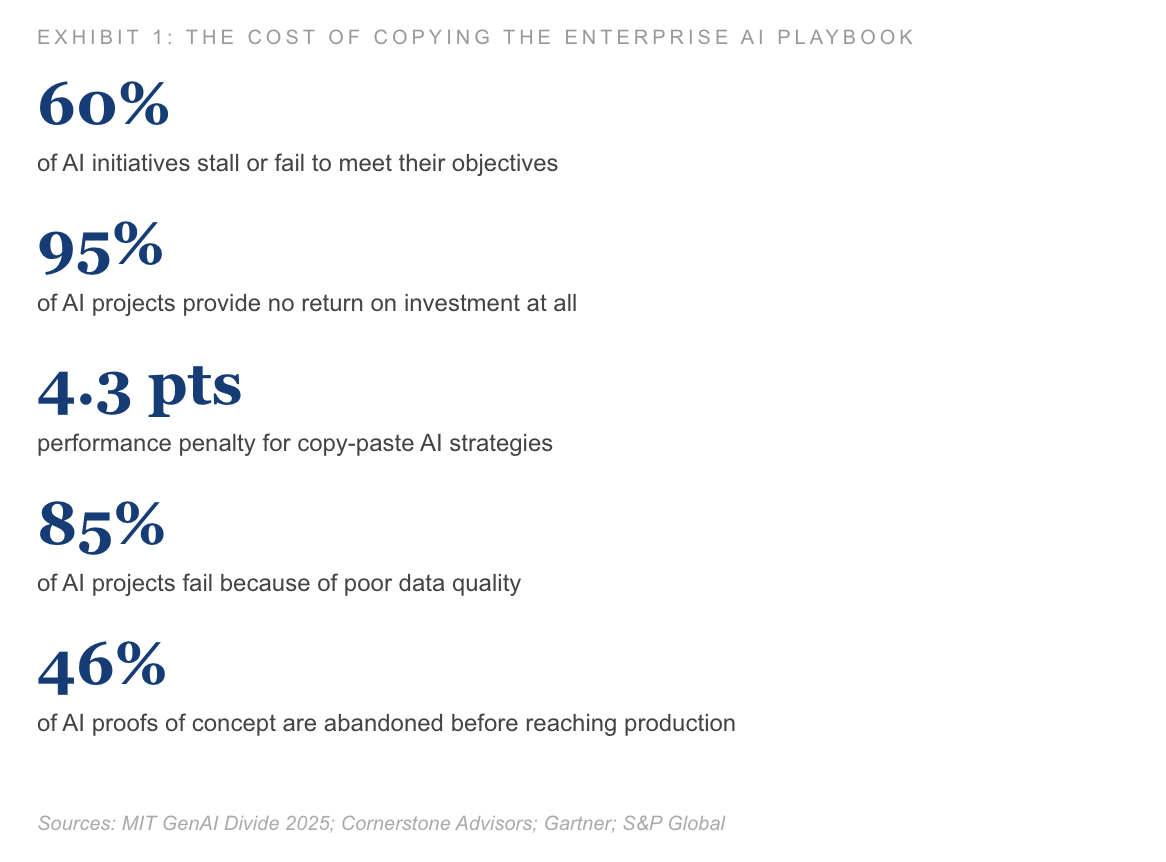
The same study, however, found that at least 60% of AI initiatives either stall or fail to meet their objectives, and 95% provide no return on investment at all.
Why the Enterprise Playbook Fails at Community FI Scale
Here is the problem. JP Morgan, Block, and most of the organizations in that MIT study are large enterprises with substantial budgets, deep IT teams, and the capacity to absorb expensive failures on their way to getting it right. Community financial institutions are none of those things.
Community banks and credit unions face a compounded version of this problem. Legacy core banking systems were not designed for AI integration. IT teams are already stretched maintaining existing infrastructure. Regulatory exposure, model risk management, bias testing, and audit trails add complexity that most enterprise AI guidance barely addresses. And there is no budget cushion for expensive course corrections.
When a community institution spends $400,000 on a failed AI project, that money does not just disappear. It delays digital banking improvements that members are waiting for, cybersecurity investments the board is asking about, and operational upgrades the team has been requesting for years.
Five Structural Traps
After conducting readiness assessments across dozens of community banks and credit unions, five consistent patterns emerge. They are not simply mistakes. They are structural traps that the enterprise AI playbook leads smaller institutions into.
We need to do something with AI. When the kickoff meeting starts with that phrase instead of here is a business problem costing us $X annually, the project is already in trouble. A regional bank spent $800,000 building a custom fraud detection model to replace a vendor solution that already had a 98.5% accuracy rate. The new model achieved 97.8%. The math was never going to work.
Our data is ready. Most AI project timelines assume data is clean, accessible, and structured. A credit union spent nine months and $400,000 before a single line of machine learning code was written because it could not reconcile data from its core, digital banking, and loan origination systems. Gartner found that 85% of AI projects fail because of poor data quality. That number is likely conservative for community institutions.
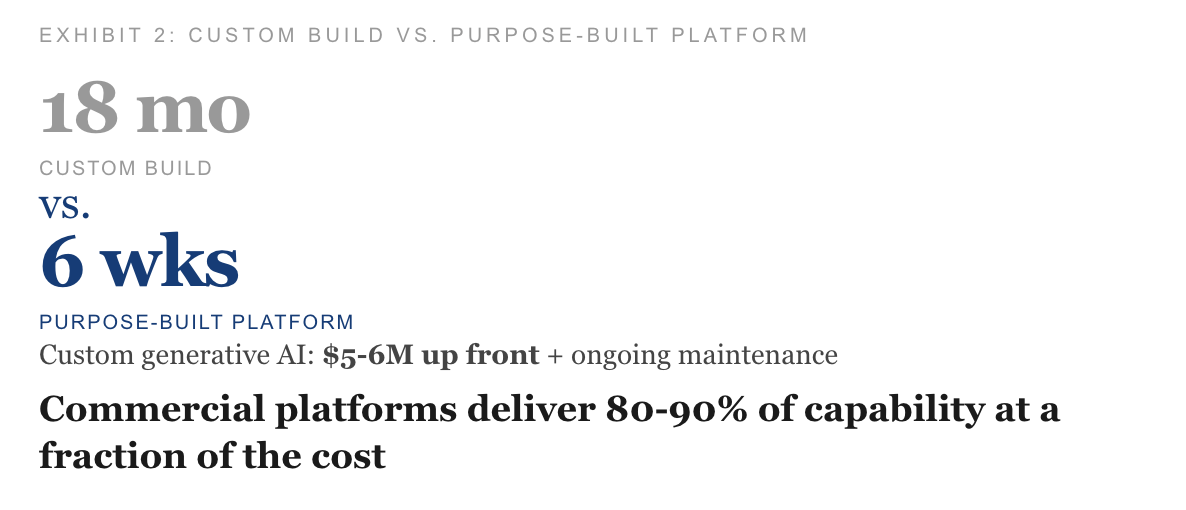
Our members are unique. We need custom. Institutions are spending 18 months and large sums to build custom NLP models even though commercial AI platforms can deliver 80 to 90% of the same capability in six weeks at a fraction of the cost. Building a custom generative AI model typically costs $5 to $6 million up front with ongoing maintenance.
We have the team for this. Many community institutions have strong analysts who understand data but not compliance, or veteran bankers who understand regulation but not technology. A $2 billion credit union experienced months of delay on a loan decisioning pilot because its data team and compliance officer could not agree on explainability standards. Neither was wrong. They just spoke different languages.
We just need to get it into production. Testing success does not guarantee production success. One community bank built a credit decisioning model that was highly accurate in testing. Deploying it required upgrading the loan origination system, rebuilding core integrations, and retraining the lending team. The last 10% of work took 14 months and tripled the original $600,000 budget.
Not All Failure Is Waste
It is worth being candid. Some institutions have failed at AI and become stronger for it. A failed pilot can be a valuable learning experience. The key is failing in a controlled, intentional way.
A controlled failure means a small, time-boxed pilot with clear success criteria, a failure threshold, and a plan to use the findings. Many community institutions now succeeding with AI point back to a failed pilot as the turning point that clarified data gaps, vendor strategy, or business scope. The difference between waste and learning is intent.
What Institutions Doing It Right Have in Common
Community banks and credit unions that are succeeding with AI take a narrower approach. They focus on specific problems, metrics, and definitions of success. They answer three questions before committing resources:
Day 90 Vision
What does success look like at day 90? Not a vague aspiration. A measurable outcome tied to a business metric.
Non-AI Alternative
What is the non-AI alternative, and what does it cost? If you cannot articulate this, you are not ready to evaluate AI solutions.
Ownership
Who owns the solution once the project team moves on? AI is a product that requires maintenance, not a project with a finish line.
They also buy before they build. Institutions seeing meaningful results in personalization are not the ones spending 18 months developing proprietary recommendation engines. They are the ones that implement platforms designed specifically for community institutions and achieve measurable outcomes faster.
What unites them is clarity of purpose before spending commitments. They know the problem they are solving, why AI is the right tool, and what they will do if it does not deliver.
Three Questions Before Spending Another Dollar
Before funding any AI initiative, run this filter:
1. Can you state the business problem in one sentence with a dollar figure?
Not improve member experience, but reduce loan application abandonment by 30%, which currently costs us $2.4 million annually in lost originations. If not, start there.
2. Have you assessed what it takes to make your data AI-ready?
Winning AI programs spend 50 to 70% of their time and budget on data readiness. If you have not done a data audit, your timeline and cost estimates are almost certainly wrong.
3. Does anyone on your team have real-world deployment experience?
Not consulting on AI, but deploying it through production, compliance, and adoption stages in regulated financial services.
If the answer to any of these is no, that is not a reason to stop. It is a reason to solve those problems before spending more on AI development.
The institutions that beat the odds are not the ones with the largest AI budgets. They are the ones that asked the right questions early, while the answers still mattered.
The real question for your institution:
Will you follow the enterprise playbook and hope for different results, or build an AI strategy that fits your scale?