



Banking Is a Commodity. So Is Losing.
Competing on rate is a strategy. It’s just not yours.
Dick Cooley, former Wells Fargo CEO, famously told Jim Collins that banking is a commodity, a “brutal fact” that Collins immortalized in Good to Great. Ever since, community institution leaders have used that phrase to justify competing on price.
When I was in business school, one of my favorite classes was a strategy course where we ran a semester-long strategy simulation. Each team would submit an entry for “the quarter” each class, and in the following class we would get a report of where each “company” sat within the industry. The interesting part was that we didn’t know what industry we were in, and the only levers we had were budget and price points.
Most of the “companies” kept changing strategy wildly each “quarter,” generally copying the company that was on top of the list. Our company decided we were going to be selling a luxury version of whatever the product was. We continued to put a lot of money into R&D and Marketing, and our prices were the highest. The company at the top for the first few “quarters” had the lowest price and spent heavily on marketing and distribution. After several “years,” the low-priced company had the largest market share, while our company had a small share. However, both companies had the largest revenue, and we had the largest income.
As we debriefed on the last day, most “companies” said they were trying to copy the low-price company. The main assumption was that the industry was selling a commoditized product. Some only changed when they saw our company suddenly in second place on revenue, but by then the market was set. There were two leaders and no one could compete.
I’ve seen parallels of that simulation, however simple it was, in banking. Leaders buy into the “banking is a commodity” mindset and try to compete on price or rates. The more they do this, the harder it gets to remain profitable and viable. There are plenty of banks that do this well. But there is a finite number of winners. All 8,585 banks and credit unions in the US cannot be fighting over rates, and yet the desire to do so is constant.
The rate war is real, and it has winners
Rate competition is not irrational. The simulation’s low-price leader was executing a real strategy. Marcus, SoFi, and the direct bank channel have proved the model works at scale. There is a genuine competitive path built on price leadership, and it requires exactly the things most community institutions cannot sustain: national distribution, technology infrastructure, and the ability to absorb compressed margins for years while market share compounds.
The simulation’s low-price company held the top spot for a long time. The strategy worked. Until the market was set and there was no room left for anyone who hadn’t staked out a position early.
That window is largely closed.
“Rate is the stated reason for switching. The research tells a different story, and most community institution CMOs are being measured on the wrong number.”
What customers say vs. what drives them
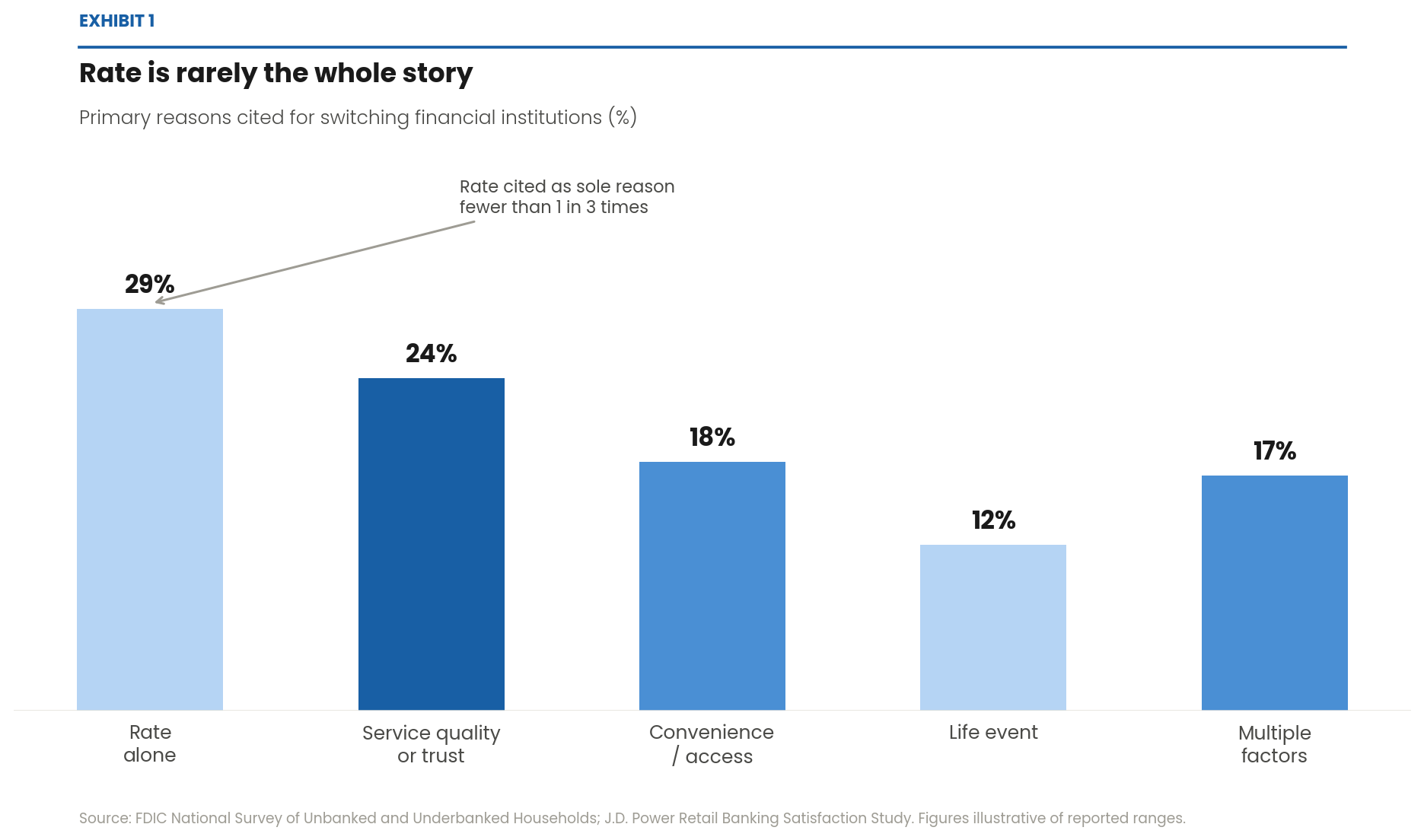
Rate is the stated reason for switching. The research tells a different story. J.D. Power’s retail banking studies consistently show that problem resolution and trust are stronger predictors of primary FI status than rate. Gallup’s banking engagement data puts the lifetime revenue differential between “fully engaged” and “actively disengaged” customers at 37 percent. FDIC survey data on switching behavior shows that fewer than a third of customers who leave an institution cite rate as the only factor, and among customers who stay despite a rate disadvantage, the dominant reasons are relationship trust, service quality, and perceived effort to leave.
Primary FI customers carry more products, generate more fee income, and cost less to retain. They are worth three to five times more in lifetime value than a customer who holds a single rate-chased CD and nothing else.
In the simulation, the low-price company had the largest market share. We had the largest income. Share and value are not the same thing. Most community institution CMOs are being measured on the wrong number.
Not all customers are the same customer
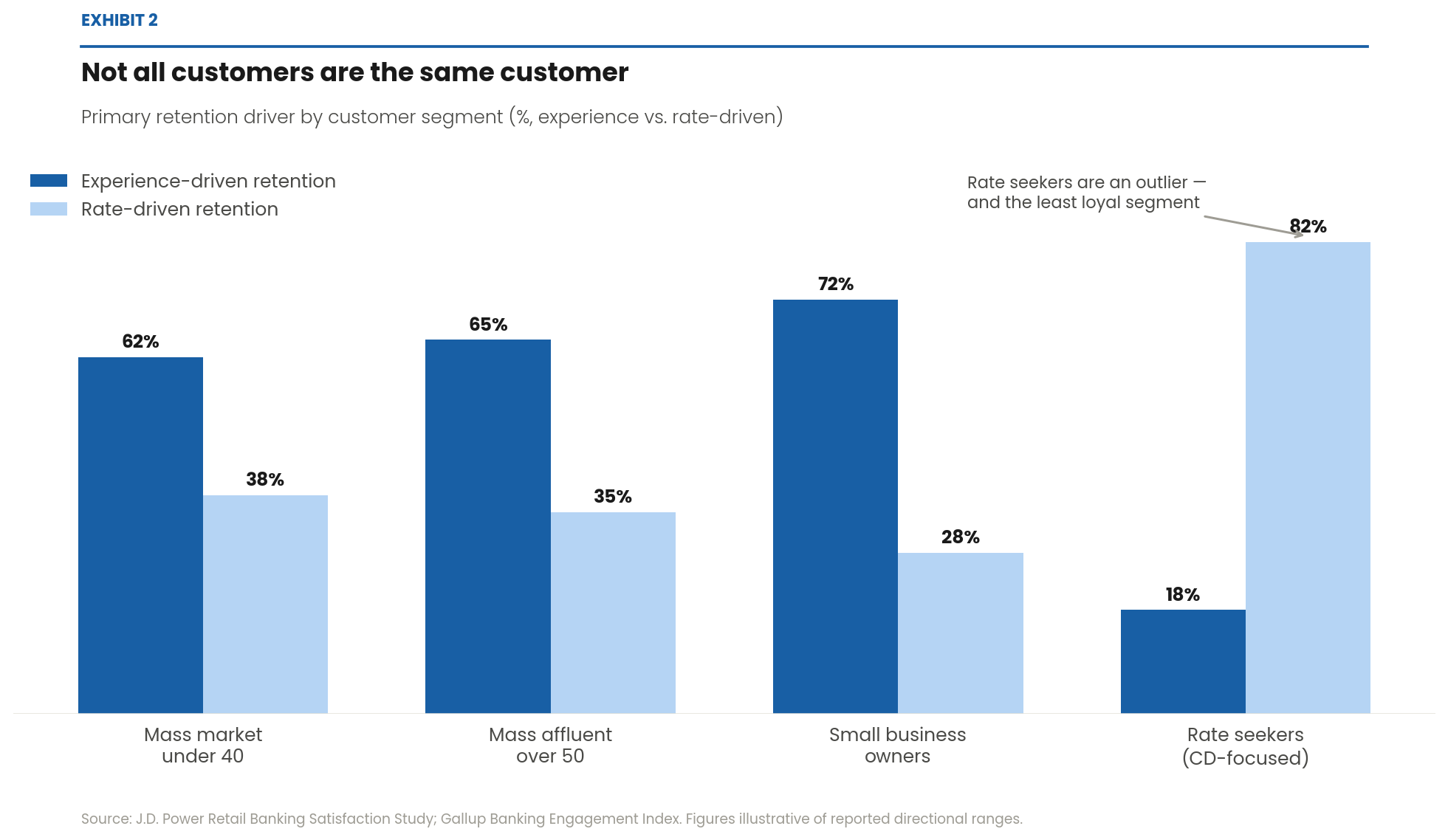
Price sensitivity is real, but it is segmented. A CD rate chaser behaves differently than a small business owner managing cash flow across four accounts. A young family financing their first home behaves differently than a retiree consolidating after years of accumulation. The CMO treating all deposit outflows as a rate problem is solving for the wrong segment.
J.D. Power data breaks this down clearly: customers under 40 and mass-affluent customers over 50 index higher on experience satisfaction as a retention driver than on rate. Small business owners consistently rank relationship access, the ability to reach a person who knows their account, above rate in primary bank selection. The CD-rate-sensitive customer is real, but that customer is also the first to leave when the next institution goes one basis point higher. Acquiring and retaining that customer is expensive and loyalty is structurally zero.
Every other team in the simulation assumed they were competing for the same customer. They were not. Neither are you.
What non-rate differentiation looks like
This is where “relationship banking” either becomes operational or remains a slogan.
Glacier Bancorp, a Montana-based community institution with roughly $27 billion in assets, has consistently posted above-peer returns while pricing deposits at or slightly above market, not at the top. Their retention advantage is traceable to a specific operating model: relationship managers are assigned to accounts, not branches, which means a business customer moving across town doesn’t lose their banker. That is a structural switching cost built on continuity, not rate.
Coastal Community institution in Washington state built a differentiation story around embedded banking partnerships with fintechs, a different kind of non-rate play, but the underlying logic is the same. They are not competing for the customer shopping rates on Bankrate. They are competing for the customer who values a banking partner with specific capabilities, and they have built the product and the infrastructure to serve that customer.
Neither example is perfect. Glacier is larger than most community banks reading this. Coastal’s model requires technical infrastructure that takes years to build. But the behavioral pattern holds across both: they made a deliberate decision about which customer they were serving, and they stopped trying to compete on a dimension where they couldn’t win.
R&D and marketing were our levers in the simulation. We were investing in a better version of the product. Not a cheaper one.
The strategic choice
Rate leader or experience leader. The simulation had no profitable middle. The companies that tried to copy both leaders split their investment, muddled their positioning, and ended the game alive but going nowhere. They had market share that didn’t convert to income, and they were too committed to the low-price model to invest in what would have differentiated them.
This is the conversation CMOs and retail banking leaders need to bring to their CEOs and boards, not as a brand positioning exercise, but as a resource allocation question. Where is the budget going? What does your conversion data say about which customers you are retaining and which ones you are losing on price alone? If the answer is that you are spending heavily on rate to win customers who leave within eighteen months, you are not executing a strategy. You are funding a cycle.
By the time the middle-of-the-pack teams in the simulation tried to change direction, the market was set. The window for this decision is open in banking right now. It will not stay open.
What the simulation didn’t teach
The simulation was clean. One product, two levers, a controlled environment. Banking is messier. Customers have complex relationships across products, channels, and life stages. Institutions carry legacy systems, regulatory constraints, and board expectations that don’t translate to a classroom model.
But the underlying logic held then and it holds now. Experience is a margin strategy. The CMOs and retail leaders reading this have the data to make the case, conversion rates by acquisition channel, retention curves by product, lifetime value by customer segment. The argument is sitting in your analytics stack. The question is whether you choose to make it, and whether you are prepared to defend a positioning decision that does not include “and we also have competitive rates” as a fallback.
Decide what you are. Then build toward it.